The Significance of the Vagus Nerve
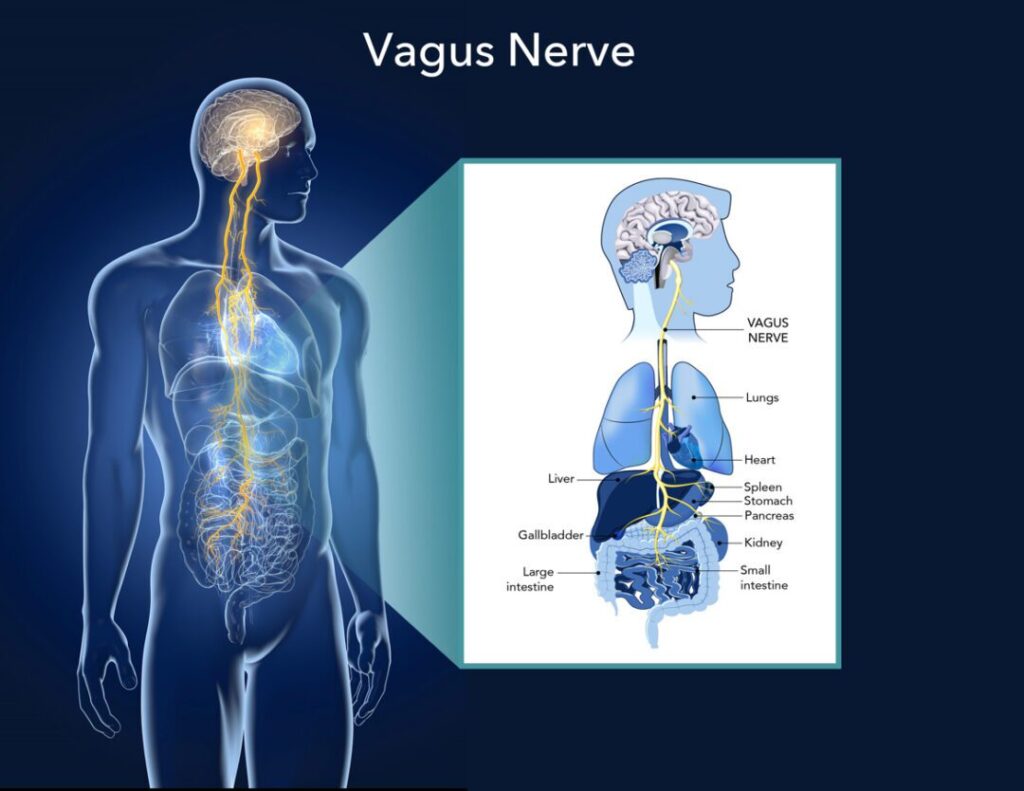
This month, I want to share some key research on the vagus nerve’s role in regulating our physiological state and emotional wellbeing.
Why? Because recent research underscores the importance of the vagus nerve in maintaining overall health, thereby highlighting the critical role of breathwork in enhancing and strengthening the vagal function. This evidence supports the assertion that deliberate breathing practices can have significant and enduring effects on both physical and mental wellbeing.
“An ability to control your vagal tone is going to optimise all these domains in your life: better sleep, your interaction with your peers, feeling less fatigued, to improving your mood. All things we need to do. The vagus nerve is going to turn out to be extraordinarily important.”
 Brief Introduction to the Vagus Nerve
The vagus nerve is the longest cranial nerve, extending from the brainstem to the abdomen. It connects the brain to organs such as the heart, lungs, and digestive tract, influencing various bodily functions essential for health and wellbeing. As part of the parasympathetic nervous system, it regulates the “rest-and-digest” responses.
Researching Its Influence…
…. On Our Mental and Emotional Health
Central to me discovering the wealth of emerging research, was Dr Porges’ Polyvagal Theory. His theory proposes, and his recent research indicates, that the vagus nerve influences our physiological state, affecting our ability to engage socially and respond to stress.
Promising evidence is emerging into the use of vagus nerve stimulation (VNS) in treating conditions like depression, PTSD, and anxiety by modulating brain circuits involved in mood regulation.
In Dr Porges recent publication ‘Vagal Nerve Stimulation Through the Lens of the Polyvagal Theory’, he further explores how vagal stimulation can dampen threat reactions and promote self-regulating functions, offering insights into therapeutic applications. Thus reinforcing the impact that the vagus nerve can play on supporting our mental and emotional wellbeing.
…. On Our Gut Health
The vagus nerve acts as communication highway between the gut and the brain, giving information about the state of the gastrointestinal tract to the central nervous system. Therefore, it facilitates a two-way communication between the gut and brain, influencing digestion, appetite, and emotional states.
Growing scientific understanding of this gut-brain connection has highlighted the vagus nerve’s crucial involvement in regulating these systems. Research shows that vagal pathways help maintain balance in the digestive tract and play a role in how we process emotions and respond to stress.
Disruptions in this communication facilitated by the vagus nerve, have been linked to a range of conditions, including obesity, gastrointestinal disorders, and even depression. Excitingly, this has led to new therapeutic approaches such as stimulation of the vagus nerve which is having positive results.
Scientific research on the gut-brain connection has shown the vagus nerve’s significant role in regulating these systems. Studies indicate that vagal pathways help maintain balance in the digestive tract and influence how emotions are processed, and stress is managed. Disruptions in this communication through the vagus nerve have been associated with various conditions, such as obesity, gastrointestinal disorders, and depression. This understanding has led to new therapeutic approaches like vagus nerve stimulation, which shows promising results.
…On Inflammation
The vagus nerve also has role to play in the regulation of our immune system by controlling inflammatory responses. A 2024 study from Duke University demonstrated that electrical stimulation of the vagus nerve in mice with colitis, a form of inflammatory bowel disease (IBD), reduced gut inflammation and improved survival rates.
To Summarise
The research underscores the critical role of the vagus nerve in sustaining overall health and wellbeing. Furthermore, it indicates that practices aimed at stimulating the vagus nerve, such as breathwork, may enhance both physical and emotional wellbeing.
Breathwork encompasses techniques that focus on the conscious regulation of breathing patterns to influence physiological and psychological states. Techniques such as diaphragmatic breathing and alternate nostril breathing can activate the vagus nerve, thereby improving its function. This activation may lead to increased heart rate variability (HRV), improved emotional regulation, and reduced stress levels. By promoting parasympathetic activation, breathwork can support vagal tone, potentially enhancing the body’s resilience to stress and contributing to emotional regulation and overall wellbeing.
Interested in learning more about breathwork, join ‘Breathe’ my four week online course provides an introduction to breathwork.